Marine autonomy takes centre stage on landmark Greenland expedition
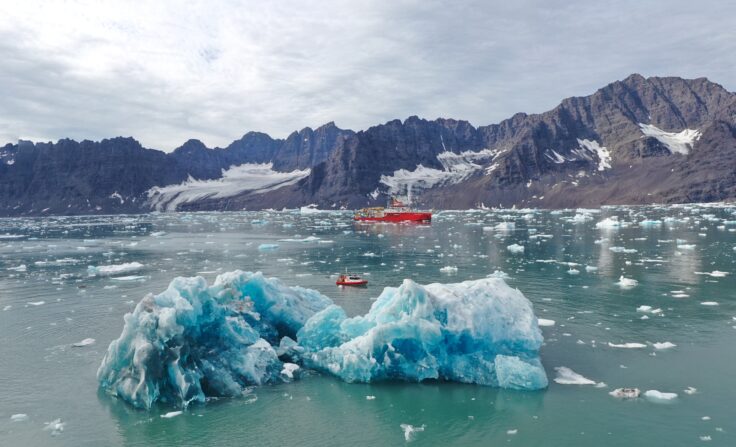
As the British Antarctic Survey's RRS Sir David Attenborough embarks on the GIANT expedition to Greenland, one of the mission's most powerful scientific assets isn't on the ship at all – it's the fleet of autonomous marine technologies working alongside it.
The expedition is using a combination of autonomous underwater vehicles (AUVs), remotely operated systems and advanced ocean sensors to investigate how warming ocean waters are driving the rapid retreat of Greenland's glaciers. These technologies will collect vital observations in areas that are too dangerous or inaccessible for ships, helping scientists better understand the processes linking ice loss, ocean circulation and climate change.
For the Future Marine Research Infrastructure (FMRI) programme, the expedition provides a compelling demonstration of the growing role marine autonomy will play in the future of UK marine science.
Extending the reach of research vessels
Research vessels remain the backbone of marine science, but today's most ambitious expeditions increasingly rely on autonomous technologies to extend their capability.
Operating beneath sea ice, close to unstable glacier fronts and in ice-filled fjords, autonomous underwater vehicles can gather high-resolution measurements of temperature, salinity, ocean currents and seabed features in environments where conventional ship-based observations are often impossible.
Working alongside the RRS Sir David Attenborough, these systems enable scientists to observe multiple parts of the marine environment simultaneously, providing a far more complete picture of the interactions between the ocean and Greenland's ice sheet.
A connected approach to marine science
The GIANT expedition illustrates how marine autonomy is becoming an integral part of modern research infrastructure rather than a standalone technology.
Data collected by autonomous vehicles are combined with ship-based observations, satellite measurements, airborne surveys and numerical models to create a comprehensive understanding of one of the world's most rapidly changing environments.
This integrated approach aligns closely with FMRI's vision for the future, where research vessels, autonomous platforms, sensors and digital systems operate as connected components of a national marine research capability.
By enabling observations over greater distances, for longer periods and in more hazardous locations, autonomous technologies can increase scientific reach while making more effective use of valuable ship time.
Accelerating scientific discovery
As marine autonomous systems become more capable, they are opening new opportunities to investigate previously inaccessible parts of the ocean.
During the GIANT expedition, autonomous platforms will help researchers examine the movement of warm Atlantic waters into Greenland's fjords and measure how these waters interact with glacier fronts. The resulting data will improve understanding of glacier melt, support more accurate climate and sea-level models, and contribute to research on potential tipping points in the Earth system.
The mission demonstrates how advances in autonomy are enabling scientists to tackle increasingly complex environmental questions with greater efficiency and precision.
Building the infrastructure of the future
The Future Marine Research Infrastructure programme recognises that autonomous technologies will be central to the UK's next generation of marine capability.
Alongside world-class research vessels, marine autonomy offers new ways to collect data, improve operational flexibility and expand scientific reach across the ocean. As technologies continue to mature, they will become an increasingly important part of an integrated research infrastructure that can respond to emerging scientific priorities and support the UK's leadership in marine science.
The GIANT expedition is a clear example of this future in action – where ships, autonomous systems and digital technologies work together to deliver the observations needed to better understand our changing planet.
Watch a short film to discover more here.