Programme overview
Informed solutions to
challenges that matter
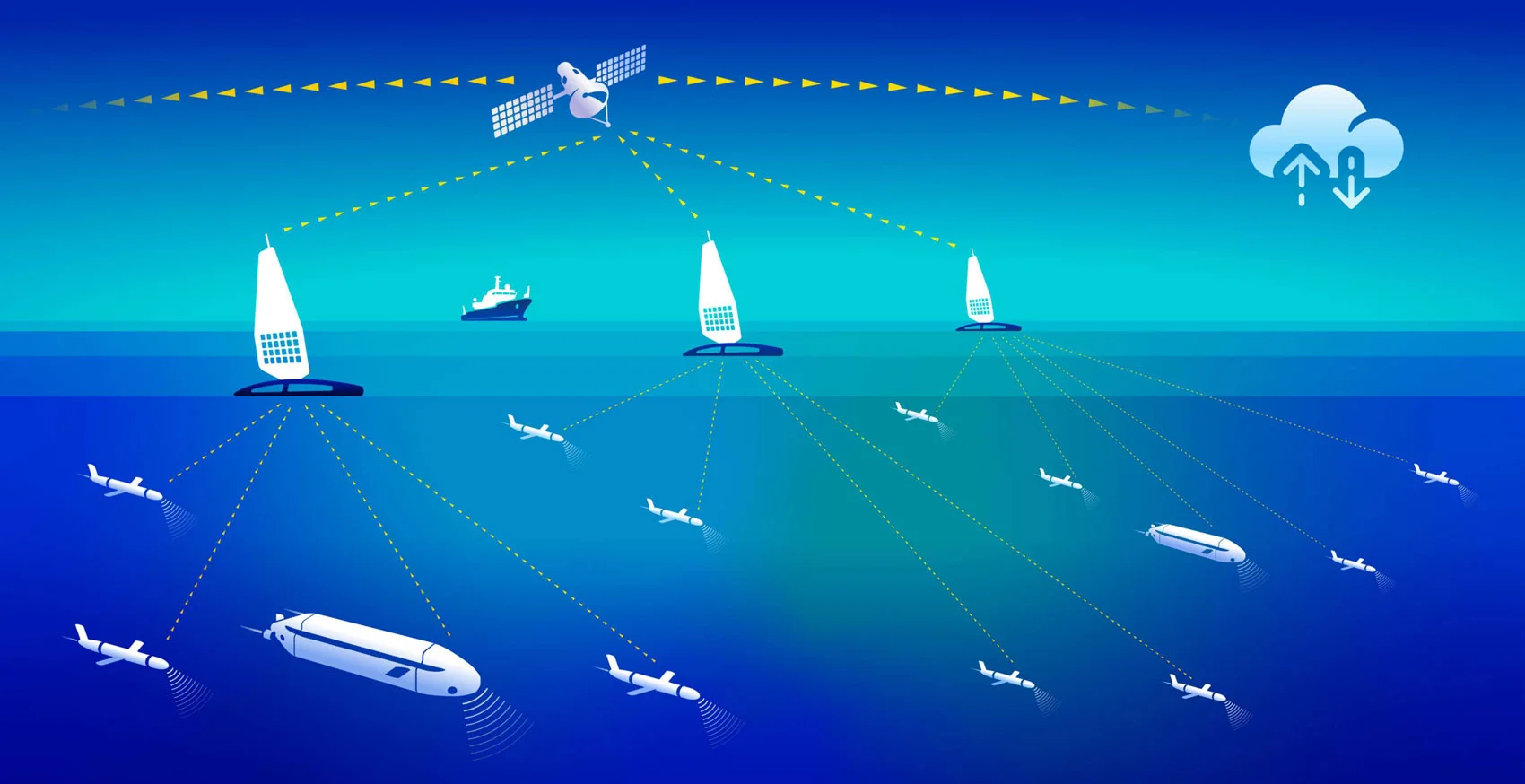
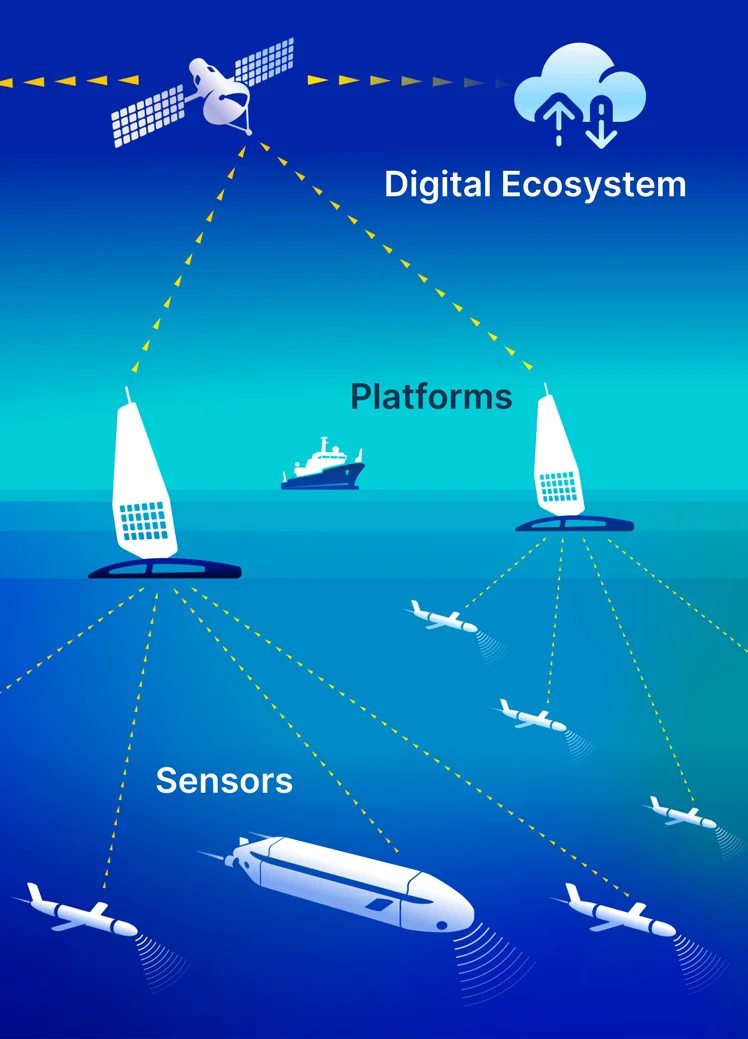
The Future Marine Research Infrastructure programme is shaping a new generation of ocean observing capability for the UK. Advanced autonomous technologies will expand access to remote and under-observed areas of the ocean, providing the data and evidence needed to understand and respond to climate change, biodiversity loss and pollution. By strengthening the UK's marine science infrastructure and technological capability, the programme will help ensure the UK remains at the forefront of ocean research and innovation.
 Objectives
Insight
Climate change, biodiversity loss and pollution are transforming our ocean, yet significant gaps remain in our ability to observe and understand these changes at the scale and frequency needed for effective decision-making. A next-generation ocean observing system would provide the long-term, high-quality data required to improve predictions, reduce uncertainty and strengthen the evidence base for responding to rapid environmental change. By expanding observations into remote and under-observed marine environments, FMRI will help deliver the knowledge needed to protect lives, livelihoods and future prosperity.
Innovation
FMRI will strengthen the UK’s marine science infrastructure through investment in advanced autonomous technologies, integrated observing networks and data-driven research capability. By bringing together researchers, industry and technology experts, the programme will create a platform for innovation that accelerates the development and deployment of new ocean technologies. This will support high-value skills and stimulate growth across the marine technology sector. In doing so, it will ensure the benefits of innovation, expertise and investment are retained within the UK.
Impact
The decisions made today in response to climate change, biodiversity loss and marine pollution will shape the future resilience, health and prosperity of our society. FMRI will transform ocean observations into actionable intelligence, providing the evidence needed to inform policy, environmental management and investment decisions. From strengthening climate resilience and supporting biodiversity recovery to enabling sustainable economic growth, the programme will help ensure that decision-makers have access to the information they need to address some of the most pressing challenges facing the UK.
Understanding our ocean
“National marine autonomy provides the scale to penetrate the world oceans including far away polar regions, presenting an unparalleled opportunity to reimagine how we observe our changing polar oceans, allowing us to move decisively toward an autonomy-led scientific delivery model. By investing in resilient, long-range uncrewed fleets, we can maintain a sustained, year-round presence in the planet's harshest marine environments while reducing our operational carbon footprint. This transition to an intelligent, autonomy-driven infrastructure is exactly what is needed to accelerate our science-to-policy pipeline, delivering the key biodiversity and climate intelligence required to safeguard UK interests including safeguarding marine ecosystems and drive global climate action.”
“In the North Atlantic, two major, ocean-related tipping points may occur due to anthropogenic climate change resulting in profound consequences for the marine environment and for the UK through rising sea levels and changes in extreme weather patterns. However, fundamental knowledge gaps remain regarding both the likelihood of these tipping points being triggered and their wider socio-economic consequences. Expanding marine autonomy would play a critical key role in reducing these uncertainties by supplementing our current ocean observing networks.”
“Digital twins of our coastal seas are essential components of a sustainable and productive future blue economy. The mass deployment of sensors on ocean floats has transformed our understanding of ocean processes, significantly improving ocean models, but we are yet to replicate this across our EEZ. Upscaling marine autonomy that can regularly make those measurements is a necessary precursor and brings the added benefit of being a rapidly deployable capability that can respond to extreme but increasingly frequent events such as marine heatwaves.”
“Ocean biodiversity underpins national security, food supply and climate resilience, yet the UK is operating with dangerously limited visibility of marine life as change accelerates across our seas and beyond. The strategic data gap is persistent, scalable biological intelligence: unlike weather or defence domains, we do not continuously observe the living ocean, constraining decision making, growth of the blue economy and effective delivery of BBNJ obligations. A major investment in autonomous biodiversity sensing would place the UK at the forefront of global innovation, creating a sovereign capability to observe, forecast and manage ocean life at scale.”
“The North Atlantic is one of the engine rooms of the Earth's climate, yet we still observe it only in fragments. We need to reveal how heat, carbon and nutrients move through the ocean, reducing uncertainty in climate prediction and strengthening our ability to respond to change. Sustained autonomous ocean observation is no longer only a scientific ambition - it is the foundation of a national strategic capability.”
“The future ocean will affect the wealth and welfare of people. The ocean absorbs a very large proportion of the pollution from humanity; it has a critical role in regulating our climate; it supports commerce and helps us defend our borders; and it is a source of much of our energy and nutrition. Yet, despite being so large and so important, it is one of the most under-observed, under-appreciated and poorly understood planetary domains. Autonomous systems are vital to ensure we have the knowledge we need in order to use the ocean intelligently for the benefit of people and the planet.”
“The seafloor is intrinsic to ocean health: it accumulates and recycles resources that directly impact biodiversity and the blue economy. The problem is we don’t yet measure seafloor properties at scales that would transform our understanding of how it interacts with the ocean column above it. We need to expand our autonomous capability to observe seafloor biogeochemical properties in new dimensions of time and space to accelerate our research and improve our models.”
““The ocean is a major sink for carbon dioxide, slowing the pace of climate change and giving us more time to trial mCDR options and develop informed mitigation/adaptation actions. However, the models and data that are confronted in the Global Carbon Budget show a persistent mismatch, almost certainly due to undersampling of the Southern Ocean in Winter, that reduces confidence in our decision-making processes, almost certainly leading to extra expenditure. Autonomous platforms exist that can address this gap, what is needed now is a sustained and well-coordinated programme to deliver this capacity, ideally lead by the UK via FMRI.””
“The crucial role of ocean circulation in controlling the pace of climate change is becoming more conspicuous year on year. However, our capacity to predict how this role will evolve in coming decades remains limited, because of the vast range of scales of flow – from centimetres to thousands of kilometres – that relentlessly shape the circulation’s behaviour. A step advance in our autonomous capability is essential to observe this breadth of scales, and unlock the understanding needed to boost our models’ predictive power.”
What is the infrastructure?
Technology



Timeline of events
Subscribe for updatesNet Zero Oceanographic Capability Scoping Study
Publication of the findings of an 18-month scoping study to explore the science/policy drivers and the technical solutions for a marine research infrastructure that can support UKRI’s net-zero ambitions.
Embedding NZOC in Digitally Enabled Ocean Science
FMRI workshop in Liverpool on the findings of the Net Zero Oceanographic Capability Scoping Study to shape the design of specific solutions.
Measurement Systems for 21st Century Oceanography
FMRI workshop in Bristol exploring the opportunities and requirements for biogeochemical sensors on autonomous platforms.
Challenger Conference
Science user engagement and Q&A panel session at the Challenger Conference in Oban, Scotland.
Science Requirements Framework Townhalls
In-person and online engagement sessions to inform the development of the FMRI Science Requirements Framework. Regional townhall events hosted in: Edinburgh, Liverpool, Exeter and London.
Autonomous Observing of Coastal and Inshore Waters
Workshop hosted in partnership with the National Centre for Coastal Autonomy in Plymouth to explore the opportunities for the use of autonomy in observing inshore and coastal waters.
A UK Science Requirements Framework for Future Marine Research Infrastructure
Publication of the findings of an 18-month consultation with the marine science community to identify the key scientific questions that will shape the future of UK marine research.
FMRI Digital Infrastructure Scoping Study
Publication of a report examining the required investment in the digital ecosystem for the FMRI concept.
Scientific and Technical Solutions
Development of the priorities identified in the Science Requirements Framework into exemplar science use cases by the FMRI Science Advisory Group in online workshop. Consultation with technical experts to develop infrastructure solutions for the use cases.
Ocean Sciences Meeting in Glasgow
An open invitation to the marine science community to attend an FMRI Town Hall to explore the question: “What kind of infrastructure could unlock the next era of ocean science, and make it compelling to invest in?”
Outline Business Case Submission
Completion and submission of the outline business case for FMRI.
Design Validation
Online engagement with the FMRI Science Advisory Group and technical experts to validate the second iteration of the target operating model.
Target Operating Model
Completion of the target operating model for FMRI to inform the case for investment.
Challenger Conference 2026
Engagement with the Early Career Researcher community about the opportunities created by FMRI.
AASI Validation Trial
Validation trial for the UKRI Infrastructure Preliminary Activity: FMRI Accelerating Adoption of Sensor Innovation (AASI).
Target Operating Model Concept
Publication of the first iteration of the target operating model for FMRI, developed from the outcomes of the Scientific and Technical Solutions workshops.